Not One Pink Shirt’s Worth
There’s a woman in a courtroom in Massachusetts who killed her three kids. Cora was five. Dawson was three. Callan was eight months old, still small enough to fit in the crook of an arm.
Lindsay Clancy killed all of them on January 24, 2023. Then she went out a second story window trying to follow them. She lived. She’s paralyzed now. She has to be wheeled into that courtroom every day to hear people describe what she did to her own children.
I keep waiting to feel one thing about this. I don’t. That’s the problem.
Her defense isn’t arguing she didn’t do it. Nobody’s arguing that. They’re arguing postpartum psychosis, bipolar disorder, a mind that broke so completely it started giving her instructions. Prosecutors say no. They say she planned it. The trial is still going as of today, August 18, 2026.
Somewhere in a hospital record there’s a version of her that was fine. Somewhere in a hospital record there’s a version of her that wasn’t. Both of those women are on trial right now and only one of them is going to walk away.
Mental illness is real. Postpartum psychosis is real, not a defense attorney’s invention, not a headline softener. Psychiatric emergencies happen in bathrooms and kitchens and nurseries every single day and most of the time nobody dies. I believe all of that.
Here’s what I can’t get past…
Would anyone be organizing a rally if Lindsay Clancy woke up tomorrow a man? Because we don’t have to guess. We have the men.
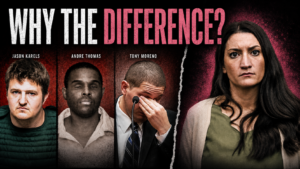
Andre Thomas started hearing voices as a kid. Ten years old, first suicide attempt. By adulthood the voices had turned into religion. A bad one. A punishing one. He believed the people around him were demons wearing human faces.
In 2004, in Texas, he stabbed his estranged wife and their two young children to death. He mutilated the bodies. Then he tried to kill himself. Then he turned himself in, because some fractured, screaming part of him still knew the difference between right and wrong even as the rest of him didn’t.
His lawyers said psychosis. Said schizophrenia. Said this man does not live in the same reality the rest of us do.
The jury didn’t care.
Death sentence. Say it flat, no music behind it, because that’s how it landed.
He gouged out one of his own eyes while he was waiting to die. Years later, in prison, he gouged out the other one. His lawyers say he ate it. Believed it would stop the government from reading his thoughts through the socket.
He is completely blind now. A man the state still, technically, intends to kill, sitting in a cell in total darkness he built himself, one eye at a time.
Nobody wore pink for Andre Thomas.
Jason Karels drowned three kids in Illinois in 2022. Bryant was five. Cassidy was three. Gideon was two. After it was done he texted his estranged wife: “If I can’t have them neither can you.”
Then he tried to kill himself too. Police found his blood in the house. Real blood, real cuts, not performance. He ran. There was a chase. Eventually he stopped running and admitted it.
He pled guilty but mentally ill. Not “not guilty.” Not “insane.” Guilty but mentally ill, a category that exists specifically to hold both truths in one hand at once: he did it, and something in him was broken when he did.
The court gave him life without parole.
At sentencing, the kids’ family stood up and called him a monster. Nobody corrected them.
Tony Moreno took his seven month old son Aaden onto the Arrigoni Bridge in Connecticut in 2015. A psychiatrist told the court he’d been ambivalent about his own life, that he’d had thoughts, real, documented, testified to thoughts, about killing the baby and then himself.
He threw Aaden off the bridge. Then he jumped.
The baby died on impact. Moreno hit the water and lived.
Think about that division of outcomes for a second. Think about what it means that gravity let one of them keep breathing.
Seventy years. That’s what a documented, testified, psychiatrist confirmed mental break got him.
Now go back to Lindsay Clancy.
Her ex husband, Patrick, the father of the children she killed, has publicly forgiven her. Her mother, her sister, her former mother in law have all taken the stand to talk about the woman they loved, the mother she used to be, how she was “begging for help” before it happened.
A forensic psychologist for the defense says he believes she was genuinely psychotic. Not faking, not performing. The defense says she described a male voice in her head, giving her orders. Prosecutors don’t buy it.
Outside the courtroom, people are organizing “Stand in Peace for Lindsay” rallies. Multiple American cities. One in the Netherlands. People are being asked to wear pink.
A GoFundMe for her parents, not her legal defense, her parents, the two people who’ve sat beside her through three years of this, has raised roughly $912,827.
Pink t shirts. Nine hundred thousand dollars. A husband who forgives. A blind man in a Texas cell who ate his own eye.
Put those next to each other and tell me what the difference is, because I don’t think it’s the psychosis.
None of this means the compassion is wrong. That’s not the argument. Maybe rallies and forgiveness and community grief funds are exactly what should happen when catastrophic illness eats a person from the inside and leaves this behind.
But then ask the next question, the one that actually costs something to ask…
Where was that instinct for Andre Thomas? Where was the rally for a man who blinded himself twice because his brain told him it was the only way to protect his own thoughts? Where was the story about a healthcare system that failed him? Where was the pink?
Where was it for Jason Karels, who pled guilty but mentally ill and still got called a monster to his face in open court?
Where was it for Tony Moreno, who jumped off the same bridge he threw his son from, and still got seventy years without so much as a fundraiser?
Andre Thomas ate his own eye believing it would save him from the government. Texas still tried to kill him for it.
This isn’t about hating Lindsay Clancy. It isn’t about pretending postpartum psychosis is fake, or telling sick mothers to stop asking for help. It’s about a much smaller, much colder fact:
Dead children are dead children. It doesn’t matter whose body carried them first.
If mental illness is severe enough to change how we understand responsibility, and it is, it absolutely can be, then that has to be true regardless of which parent it broke. It can’t stop being true the second the person in the defendant’s chair has a beard instead of a diagnosis of postpartum depression.
If a mother destroyed by psychosis can be both responsible for the unthinkable and still worthy of forgiveness, of rallies, of nine hundred thousand dollars raised on her behalf, then somebody has to explain why the fathers we broke the same way got nothing but a cell and a number.
Maybe Lindsay Clancy deserves every bit of the grace she’s getting.
But if she does, then somewhere there’s a blind man in Texas, and a man serving seventy years for a bridge, and a man who will die in prison for a lake, who deserved some of it too. And they didn’t get it. Not one pink shirt’s worth.
Compassion for severe mental illness isn’t the problem. The uncomfortable question is why that compassion seems so much easier to extend in some cases than others.