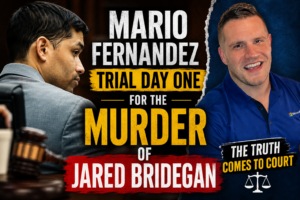
Mario Fernandez-Saldana Trial Day One: Prosecutors Lay Out Jared Bridegan Murder Case as Defense Challenges Key Links
The murder trial of Mario Fernandez-Saldana opened with two dramatically different accounts of the evidence surrounding the February 2022 killing of Jared Bridegan.
Prosecutors told jurors Bridegan’s death was not a random act of violence, describing the shooting as intentional and deeply personal. The State identified Bridegan’s ex-wife, Shanna Gardner, and her husband, Fernandez-Saldana, as central to its theory of motive.
Fernandez-Saldana is charged with first-degree premeditated murder and solicitation to commit a capital offense. He is presumed innocent unless and until the State proves the charges beyond a reasonable doubt.
Prosecutors: The Tire Was a Trap
The State began by taking jurors back to the night of February 16, 2022, when Bridegan had just dropped off the two children he shared with Gardner and was traveling through Jacksonville Beach.
According to prosecutors, Bridegan encountered a tire obstructing the roadway. He stopped, placed his vehicle in park, activated his hazard lights and got out to move it.
That, prosecutors argued, was exactly what the killer expected him to do.
The State told jurors that a figure emerged from the darkness with a firearm and fired four 10mm rounds. Two bullets entered Bridegan’s vehicle, allegedly passing within inches of his two-year-old daughter, Bexley, who remained strapped into her car seat. Two other bullets struck Bridegan.
The prosecution went so far as to characterize the tire itself as an integral part of the murder, arguing it was used to force Bridegan out of his vehicle and into a vulnerable position. Surveillance footage and the pattern of gunfire, prosecutors said, led investigators to conclude early on that the killing was deliberate rather than random.
A Blue Truck Before and After the Murder
A major part of the State’s opening centered on a blue pickup truck prosecutors say was connected to Henry Tenon.
According to the State, surveillance captured the truck before the homicide carrying what appeared to be a tire in its bed. After Bridegan was killed, cameras allegedly captured the same truck traveling away from the area without the tire.
Prosecutors also emphasized the timing and location of the ambush. They argued the person who orchestrated the killing would have needed to know Bridegan would be in Jacksonville Beach that evening and would likely take the residential route where he was attacked. The State told jurors that Gardner and Fernandez-Saldana were among the relatively small number of people who knew those details.
The State’s theory is expected to rely heavily on a chain of circumstantial evidence connecting the truck, Tenon and ultimately Fernandez-Saldana.
Checks Written After Bridegan’s Death
Prosecutors also previewed financial evidence they say connects Fernandez-Saldana to Tenon.
The State told jurors that investigators examined Tenon’s bank records and discovered that in March and April 2022, weeks after Bridegan was killed, Tenon deposited three checks written by Fernandez-Saldana. One of those checks was for $2,000 and contained “landscaping” in the memo line.
The significance of those payments is sharply disputed.
The prosecution presented them as part of the broader relationship between Fernandez-Saldana and Tenon. The defense, however, told jurors there was an innocent explanation: Tenon had performed legitimate work for Fernandez-Saldana, including landscaping, roofing, tree and tile work.
That disagreement may become one of the central battles of the trial: whether apparently ordinary transactions become incriminating when viewed alongside the rest of the State’s evidence.
The State Previews a 10mm Glock Connection
The firearm evidence also featured prominently in opening statements.
Investigators determined the ammunition used in Bridegan’s killing was consistent with a 10mm Glock, prosecutors told the jury.
The State further described Fernandez-Saldana’s longtime friendship with John Biggerstaff and told jurors about an older-model 10mm Glock connected to Biggerstaff. According to the prosecution, Biggerstaff’s father had previously surrendered firearms after becoming a convicted felon, including an older-model Glock 10mm.
Prosecutors say that firearm evidence will form another piece of the chain connecting the alleged plot to Fernandez-Saldana.
The defense immediately challenged the significance of that connection, noting that thousands of Glock 10mm firearms have been manufactured and arguing that investigators focused too narrowly on Biggerstaff’s gun.
Defense: Where Is the Direct Evidence?
While prosecutors asked jurors to look at the evidence collectively, the defense urged them to examine what it says is missing.
Attorneys for Fernandez-Saldana told the jury they will not see a text message, email or other communication showing Fernandez-Saldana directing Tenon to kill Bridegan. The defense argued there is no witness who can testify that Fernandez-Saldana encouraged, assisted or instructed Tenon to commit the murder.
The defense also attacked the physical evidence.
Jurors were told investigators did not recover Fernandez-Saldana’s hair, fingerprints, DNA or skin cells from the truck the State links to the killing.
And while surveillance footage may show a blue truck moving through Jacksonville Beach, defense attorneys stressed another point: they say the videos do not show Fernandez-Saldana inside it.
The defense also reminded jurors that Shanna Gardner was repeatedly discussed during the prosecution’s presentation but Fernandez-Saldana is the person on trial in this proceeding, telling jurors their focus must remain on the evidence against him.
The competing narratives were clear by the end of openings.
The State says the individual pieces fit together to expose a coordinated murder plot.
The defense says those pieces do not establish that Mario Fernandez-Saldana participated in one.
First Witnesses Reconstruct the Night Bridegan Was Killed
After opening statements concluded, the State began presenting testimony.
Cruz was the prosecution’s first witness.
The State later called Shane Borja, followed by Sgt. Lawrence Smith.
Their testimony helped establish what happened immediately after the shooting.
The jury heard that passing motorists came upon Bridegan’s stopped vehicle with its hazard lights activated and Bridegan lying face down on the roadway.
Smith described emergency efforts at the scene, including CPR. By the time he went to check Bridegan’s vehicle, the child who had been inside had already been removed from it.
Kirsten Bridegan Takes the Stand
One of the day’s most personal witnesses was Kirsten Bridegan, Jared’s widow.
She described February 16 as an otherwise ordinary day.
Bridegan had been working from home and later left for a previously scheduled outing with his children. Kirsten testified there had been no unusual change in the schedule that evening.
She said Jared typically drove the family’s black Volkswagen Atlas for those outings. While he was gone, she remained home, put their daughter London to bed and spent the evening with her parents. She also communicated with Jared while he was out.
Kirsten recalled speaking with Jared after he had dropped off the twins at their mother’s home. Their young daughter Bexley remained in the vehicle with him, and Kirsten testified she could not hear anyone else inside the vehicle during the conversation.
It was testimony that placed the jury inside the final ordinary moments before the ambush prosecutors say had been carefully planned.
Medical Examiner: Bridegan Died From Multiple Gunshot Wounds
The State’s final witness of the day was Dr. Peter Gillespie, who testified about the autopsy findings.
Gillespie concluded that Bridegan died as a result of multiple gunshot wounds and classified the manner of death as homicide. He also testified that his examination supported an approximation that the firearm was at least two to three feet from Bridegan when it was fired.
The defense declined to cross-examine the medical examiner, and the court confirmed he was the final witness of Day One.
Day One Defines the Fight Ahead
The first day of testimony did not resolve the central question of the trial. Instead, it sharply defined it.
The prosecution is asking jurors to follow a trail: a bitter family dispute, knowledge of Bridegan’s movements, a tire allegedly used as a trap, a blue truck tied to Henry Tenon, financial transactions, firearm evidence and relationships that prosecutors say ultimately lead back to Fernandez-Saldana.
The defense is asking jurors to focus on the gaps between those pieces: no video showing Fernandez-Saldana in the truck, no physical evidence recovered from it tying him to the vehicle, and no message or witness directly documenting an order from Fernandez-Saldana to murder Jared Bridegan.
For jurors, the question over the coming days will be whether the State can turn that circumstantial chain into proof beyond a reasonable doubt, or whether the missing links emphasized by the defense leave them with reasonable doubt.