The alias, the lawsuit, the pattern: unraveling the Jonathan Lee Riches trail
Jonathan Lee Riches has spent much of his adult life tied to fraud and deception, and according to Wikipedia, he served federal prison time for wire fraud before his release in April 2012. Even after that incarceration, his name continued to surface in a steady stream of unusual lawsuits, hoaxes, and filings that pushed the limits of the court system.
That history provides key context to a 2016 federal lawsuit filed under the name of Kalamazoo shooting suspect Jason Brian Dalton, a case that quickly gained national attention before it was exposed as a hoax.
The lawsuit, filed in the Eastern District of Michigan, accused Uber Technologies Inc. of violating civil rights and sought $10 million in damages. It alleged unpaid wages, unsafe working conditions, psychological harm, and even claimed the company played a role in the plaintiff’s incarceration and personal downfall.
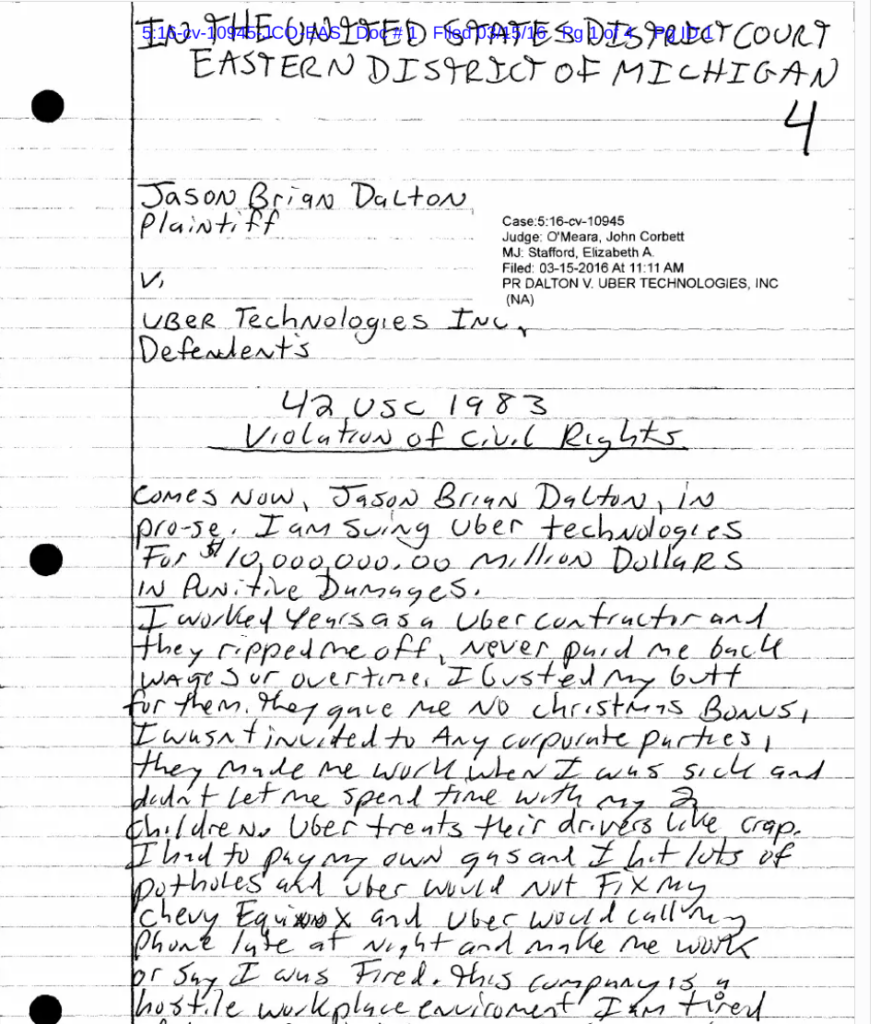
Because it was filed under Dalton’s name, the complaint initially fueled speculation about a connection between Uber and the deadly shooting spree.
That theory unraveled quickly.
Investigators later determined Dalton did not file the lawsuit. Reporting at the time said handwriting analysis did not match, and authorities stated he had no involvement. Coverage also noted that the filing was mailed from Philadelphia, not from the Michigan jail where Dalton was being held, raising immediate questions about who was actually behind it.
Reporting from that period indicated that Jonathan Lee Riches, a prolific filer known for bringing thousands of lawsuits, said he was behind the $10 million Uber lawsuit filed under Dalton’s name. That shifted the focus away from the complaint itself and onto a man whose litigation history had already become notorious.
That pattern is not new.
In a 2007 federal case filed in the Southern District of Florida, Riches, using his real name, submitted a civil rights complaint alleging that a group called “Government Snitches and Informants Inc.” was responsible for crimes including genocide, war crimes, piracy, slavery, injury to wildlife, and threats against the president. He also claimed the defendants had placed computer chips and parasites in his brain and sought more than $429 trillion in damages. A magistrate judge recommended dismissal, finding the complaint failed to state a claim and describing the allegations as frivolous and non cognizable.
Additional filings show similar themes.
In a handwritten complaint filed in Florida state court, Riches sued former NASA astronaut Lisa Nowak in a case titled “Harassment Out of This World.” In that filing, he alleged the two began talking online in April 2007, exchanged emails and photographs, and later arranged to meet in Orlando. He claimed Nowak promised to sneak him onto a future space mission and bring him moon rocks from Mars. He further alleged that when she arrived at his home, she was not the woman depicted in the photographs, became angry when confronted, forced her way inside, pulled out a butter knife, struck him with a suitcase, threatened to kill him, took cash and credit cards from his wallet, ripped the phone jack from the wall so he could not call police, and left him with cuts, bruises, and a dislocated ankle. The complaint sought roughly $2.5 million in damages.
The document, like others attributed to Riches, was handwritten on lined paper and combined real public figures with sensational and highly unusual claims.
Across these cases, consistent patterns emerge: handwritten filings, expansive allegations, extraordinary damages demands, and the use of real names or high profile individuals in ways that attract immediate public attention. That broader record is one reason the Dalton Uber filing drew so much scrutiny once questions emerged about its authenticity.
Federal courts allow individuals to file lawsuits without an attorney, but under 28 U.S.C. §1915, judges can dismiss complaints that are frivolous or fail to state a valid claim. In practice, that means a filing can briefly enter the public record and generate headlines before it is fully tested in court.
The Kalamazoo Uber lawsuit is one of the clearest examples of that gap. Filed under the name of a high profile criminal defendant, it created immediate headlines before investigators concluded it was not legitimate.
Placed alongside earlier filings, including the Florida federal case and the Lisa Nowak complaint, the Michigan lawsuit fits into a broader pattern tied to Jonathan Lee Riches, one that appears to have continued long after his prison sentence ended.
While the filings themselves rarely survive meaningful legal review, they leave behind a consistent paper trail that reflects not just repeated litigation, but a recurring use of the court system as a platform for attention, disruption, and alleged deception.
Recently, as allegations of abuse involving JLR Investigates have begun to circulate publicly, he took to X and posted, “Some of y’all getting played. Big time!”
The statement comes against the backdrop of his own documented history. In a 2019 interview with The Huffington Post, Riches said, “I don’t think about the long-term consequences as far as disinformation or offending anyone.” He added, “The disinformation that I want, I can put out there. The next mass shooting, before they identify the shooter, I can set up 10 Twitter accounts looking like news sites and then create whoever I want as the shooter … Vulnerable, gullible people will see that, they think it’s from a news site and then they will copy it and tweet it out.”
Recent research indicates he has been linked to more than 15 Facebook accounts, and when considered alongside his 2019 statements about spreading disinformation, it raises significant questions.
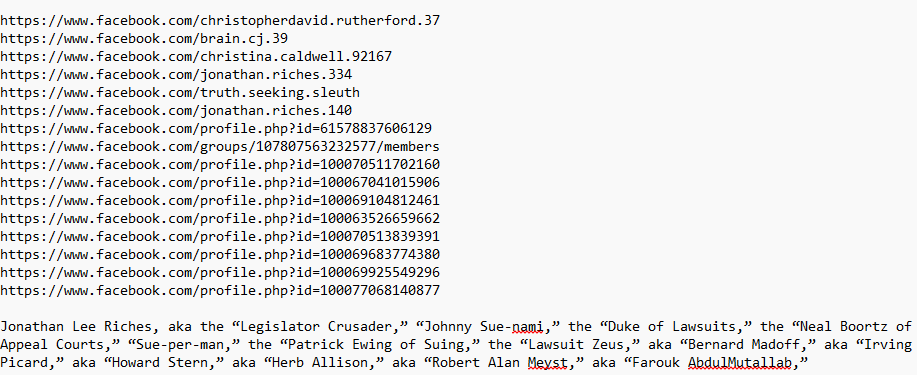
Those statements do not exist in a vacuum. Set against his long record of litigation, deception, and public conduct, they cast a deeper shadow over his recent remarks and serve as a reminder that when someone openly boasts about manufacturing disinformation, every new claim deserves far more scrutiny than trust.