What started as a short TikTok video in mid-June has now become a multi-defendant civil lawsuit unfolding in a Florida courtroom, drawing renewed attention to the real-world consequences of viral amplification.
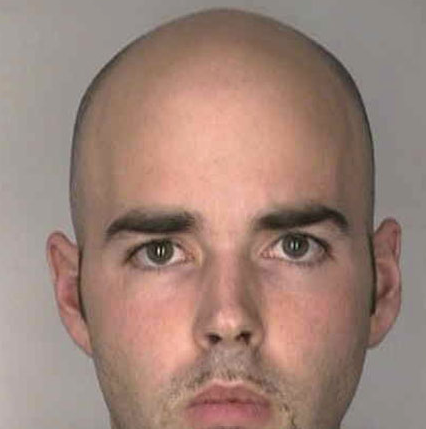
Court records show that Travess Matthew Wolford, a private individual from St. Petersburg, Florida, has filed a First Amended Complaint in Pinellas County Circuit Court naming TizzyEnt (real name Randall Michael McWhorter), Michael Shawn Tenenblatt, and DigiverseTech LLC as defendants. The lawsuit alleges defamation, cyberstalking, and coordinated harassment tied to a series of viral social media posts that the plaintiff says upended his life.
According to the amended filing, the amount in controversy exceeds $50,000, and the plaintiff is seeking compensatory, special, and punitive damages, as well as injunctive relief and a jury trial.
The Video That Started It
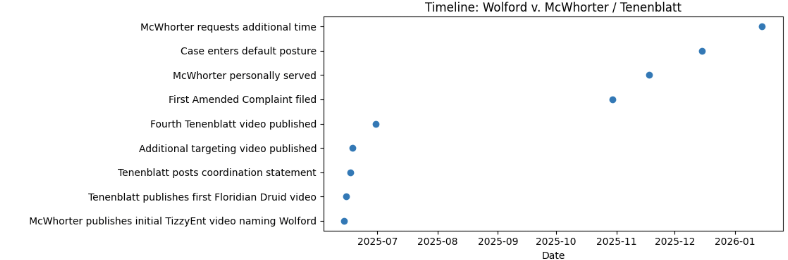
The case traces back to June 14, 2025, when McWhorter, operating under the name TizzyEnt, published a TikTok video identifying Wolford by full name and city. In the video, McWhorter used language the complaint describes as falsely imputing criminal intent, including the word “premeditation,” and suggested Wolford should be “looked at” if future “incidents” occurred in the area.
The lawsuit alleges that McWhorter did not simply react in the moment. Instead, it claims he researched Wolford off-platform, sourced personal images, edited the video deliberately, and then republished the same content across TikTok, Instagram, X, and YouTube, each time to a new audience.
Within days, the content had reached millions.
Amplification and Escalation
Beginning June 15, TikTok creator Michael Shawn Tenenblatt, known as Floridian Druid, entered the narrative. Over the next two weeks, Tenenblatt published multiple videos about Wolford, repeatedly referencing his employer, applying the nickname “Temu Adam Sandler,” and framing Wolford’s continued employment as a matter of public concern.
“Between Tizzy’s post and my post… he’s gone.”
In one video posted on June 17, Tenenblatt stated, “Between Tizzy’s post and my post… he’s gone,” a line the plaintiff cites as evidence of coordination and joint action. Comment sections beneath the videos allegedly filled with calls to contact Wolford’s employer, negative reviews, and celebratory reactions as consequences unfolded.
The complaint argues that this was not spontaneous outrage, but a predictable chain reaction set in motion by creators who understood the reach and behavior of their audiences.
Real-World Fallout
Wolford alleges that the online campaign led to his termination, ongoing harassment, financial instability, and the eventual loss of his home. He describes waves of attention that did not fade, but resurfaced with each new post, stitch, or update video.
The lawsuit also names DigiverseTech LLC, a Michigan-based company, alleging it republished the original TizzyEnt video on Facebook, extending the same claims and imagery into yet another platform ecosystem.
From Screens to Summons
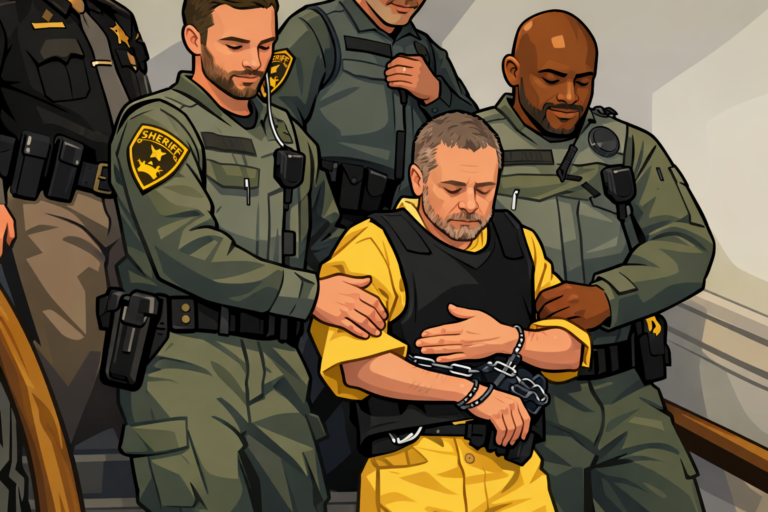
By late 2025, the dispute had fully entered the legal arena. Court documents show that Randall Michael McWhorter was personally served with the amended complaint in Florida in November. After no timely response was filed, the case briefly entered default posture, before McWhorter responded requesting additional time.
The filing clarifies that all defendants are now formally named, served, and subject to the court’s jurisdiction. Motions are pending, including a motion to dismiss filed by Tenenblatt, with an in-person hearing scheduled for January 2026.
Why This Case Is Being Watched
At its core, the lawsuit raises a question courts are increasingly being asked to answer: when does online commentary cross the line into coordinated harm?
The amended complaint does not frame the issue as a single insult or a heated opinion. Instead, it lays out a detailed timeline of edits, reposts, captions, and calls to action, arguing that repetition, scale, and intent matter—especially when accusations of criminal behavior are broadcast to millions.
No findings on liability have been made, and the defendants have not yet filed full substantive responses to the claims. But the case already stands as a cautionary snapshot of how quickly digital attention can translate into offline consequences—and how difficult it can be to put that genie back in the bottle.
For now, what began as a viral moment continues its slow, methodical march through the courts.
About the Author